The short answer: Rangoli is a colorful design made on the floor at the entrance of a home, using colored powders, rice flour, flower petals or sand. During Festivals and Diwali, families draw rangoli at the doorstep to welcome guests, good fortune and Goddess Lakshmi. Every region of India has its own name and style for it, from kolam in Tamil Nadu to alpana in Bengal, and it is one of the easiest (and most colorful) Diwali traditions to share with children, even if you live somewhere far too cold to draw one outside.
Every Diwali when I was growing up in India, the day began with the floor. Before the sweets, before the new clothes, before the sparklers, someone would sweep the entrance clean and the colors would come out. My sister and I would have a Rangoli competition and guests coming over would be the judges. We took this very seriously and created masterpieces (as per us kids) which were colorful, had various motifs, and were huge in size.
Rangoli and sparklers were the biggest highlight of Diwali for me as a kid. So when I became a mom here in the Northeast, rangoli was the tradition I wanted to hand to my children most.
And then November came. If you live anywhere near me, you know what Diwali weather looks like: cold, wet, windy, sometimes even an early dusting of snow. There was no doorstep rangoli to be made. Powder blows away. Chalk washes off in the rain. I tried a few times indoors with real colors, and let’s just say my rug and my toddler did not agree on where the pink powder should go.
I remember feeling bummed about it. This was the art I grew up with, the thing that made Diwali feel like Diwali, and I couldn’t share it with my own kids the way it was shared with me.
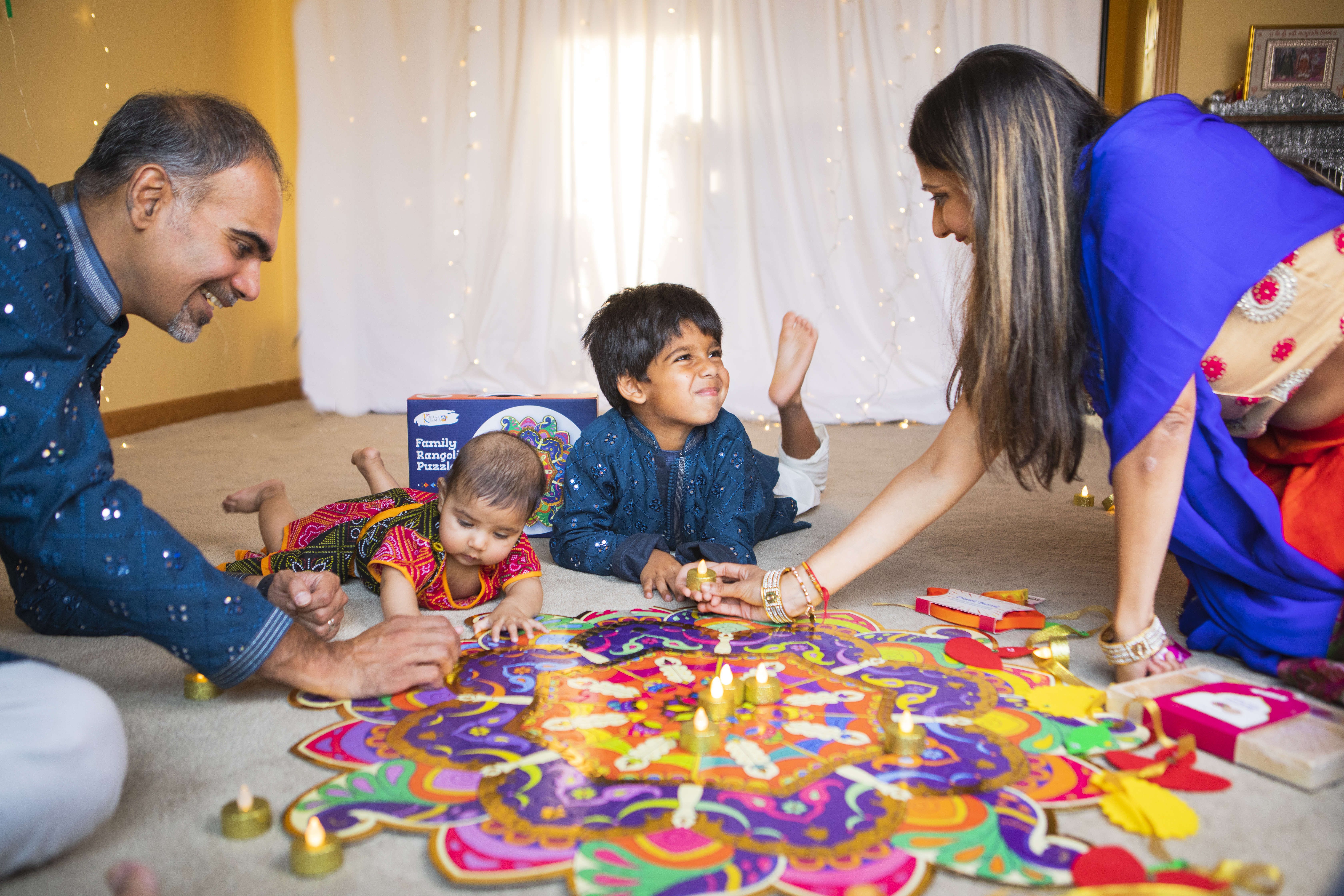
So I did what moms do. I solved this problem. I turned rangoli into a giant floor puzzle, big enough for little hands, bright enough to light up a living room, and mess-free enough to bring out again and again. That was the very first product I ever made at Kulture Khazana: the Rangoli Mandala Floor Puzzle, 32 inches across, the first rangoli floor puzzle of its kind. My son and I built it on our living room floor that Diwali, and for the first time, rangoli was at the heart of our home again.

Today it’s one of our most-loved pieces, and I still get messages from moms who tell me it’s the first time their children have asked, “What is rangoli?” This post is my answer, for you and for them. Grab a chai. There’s more to this beautiful art than most people know.
What is rangoli?
Rangoli is a decorative floor art from India, usually made at the entrance of a home, in a courtyard, or near the family altar. The word is often traced to the Sanskrit rangavalli, meaning “a row of colors.” Designs range from simple geometric patterns and dots to lotuses, peacocks, diyas, mango leaves and elaborate mandalas.
Traditionally, rangoli is made by hand, with no stencils, by letting colored powder or colored rice slip between the thumb and forefinger in a thin, steady line. It’s an art most of us learned not in a class but by sitting next to our mothers, aunties and grandmothers, which is part of why it carries so much feeling.
Why do we make rangoli for Diwali and other Festivals?
Diwali is the festival of lights, and rangoli is how a home says “welcome.” It’s drawn at the threshold, the meeting point between the outside world and the home, to invite in Goddess Lakshmi, who brings prosperity and good fortune. Many families also draw tiny footprints leading from the doorway into the house, so Lakshmi knows the way in. Diyas are placed on and around the design, so that on Diwali night, light and color meet at the door.
Rangoli is made throughout the five days of Diwali, and especially on Dhanteras and on Diwali itself, when homes are freshly cleaned and decorated for Lakshmi Puja. In Gujarat and many other homes, a fresh rangoli also greets the New Year the morning after Diwali.
Rangoli is also created for Holi, Ganesha Chaturthi, Onam, and so many other festivals throughout the year.

One art, many names: rangoli across India
“Rangoli” is the name most people know, but nearly every region of India has its own version, with its own name, materials and meaning. If your family calls it something different, you’re not wrong. You’re part of a beautiful, much bigger story.
| Region | Name | Made with | What makes it special |
|---|---|---|---|
| Gujarat, Maharashtra, North India | Rangoli | Colored powders, white stone powder | Bright, bold designs at the doorstep for Diwali and the New Year |
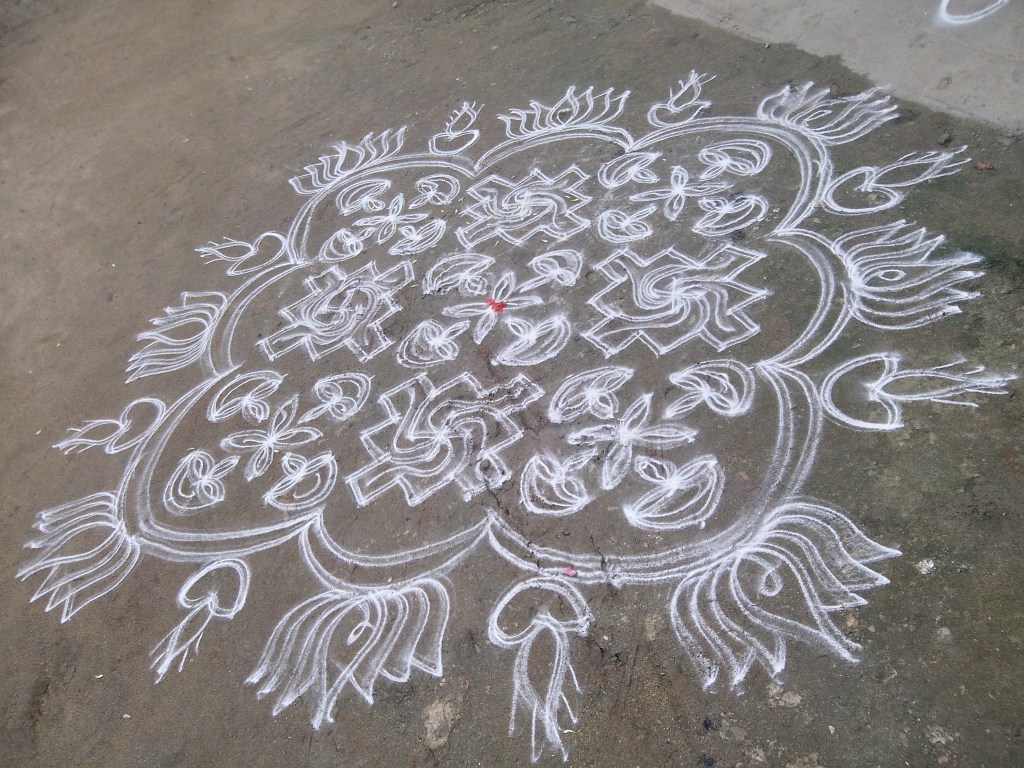
| Tamil Nadu | Kolam | Rice flour | Drawn fresh every morning, often in white, around a grid of dots |
| Andhra Pradesh & Telangana | Muggu | Rice flour or chalk powder | Intricate dot-and-line patterns, especially large during Sankranti |
| Karnataka | Rangavalli | Rice flour, colored powders | Closest to the old Sanskrit name for the art |
| Kerala | Pookalam | Fresh flower petals | Made mostly for Onam, layered in rings of flowers |
| West Bengal | Alpana | Rice paste, painted with the fingers | Flowing white designs and Lakshmi’s footprints for Lakshmi Puja |
| Odisha | Jhoti or Chita | Rice paste | Drawn on floors and walls, often with Lakshmi’s feet and paddy motifs |
| Bihar (Mithila) | Aripan | Rice paste | Sacred floor designs connected to the Madhubani art tradition |
| Rajasthan & Madhya Pradesh | Mandana | White chalk on red earth | Painted on floors and walls of homes |
| Uttarakhand (Kumaon) | Aipan | Rice paste on red ochre | Striking white-on-red designs at doorsteps and altars |
| Uttar Pradesh | Chowk Purana | Flour, colored powders | Square designs drawn for pujas and celebrations |
| Nepal | Rangoli during Tihar | Colored powders | Lakshmi’s footprints, and Mha Puja mandalas in Newar families |
Lesser-known facts about rangoli
This is the part I love sharing with grown-ups, because almost everyone who grew up with rangoli is surprised by at least one of these.
- Kolam was made to feed others. Traditional kolam is drawn with rice flour so that ants, birds and other small creatures can eat it during the day. It’s a quiet daily act of generosity, a way of sharing food with the world before your own family eats.
- It’s meant to disappear. Rangoli isn’t made to last. It’s walked over, blown by the wind and swept away, and then made again. There’s something deeply beautiful in that: you put your best effort into something you know won’t stay, simply because the welcome matters.
- Some designs are drawn in one unbroken line. In a style of kolam called sikku kolam, a single continuous line loops around a grid of dots without ever lifting off the ground. Mathematicians and computer scientists have studied these patterns for their symmetry and logic. Your grandmother was doing geometry before breakfast.
- The dots come first. Many rangoli and kolam designs begin with a grid of dots that acts like a map. Change the number of dots and you change the entire design. It’s a wonderful way to teach children patterns and counting.
- The colors came from the kitchen and the earth. Long before store-bought powders, rangoli was made with rice flour, turmeric, kumkum, crushed leaves, flower petals, brick dust and charcoal. Many families still use rice flour, lentils and flowers today.
- Lakshmi gets her own footprints. In Bengal, Odisha, Gujarat and many other homes, small footprints are drawn leading into the house at Diwali so Goddess Lakshmi can find her way in. It’s one of the sweetest details to recreate with kids.
- It’s not only for floors. Mandana in Rajasthan and Jhoti in Odisha are painted on walls as well as floors, turning the whole home into a canvas.
- It isn’t just for Diwali. Rangoli and its cousins appear at weddings, Pongal, Sankranti, Onam, Navratri and housewarmings. In Tamil Nadu, many women draw a fresh kolam at their door every single morning.
“Rangoli was the art I grew up with. It is one of my fondest memories of creating one with my Grandmother, Mom, and my sister. I couldn’t make one outside my door here, and I couldn’t share it with my kids. So I turned it into a giant puzzle.”
— Akruti Babaria, founder of Kulture Khazana
How to explain rangoli to kids
When I visit classrooms, this is how I explain rangoli to a room full of five-year-olds: “On Diwali, we make a beautiful pattern on the floor right by our front door, using colored sand, flowers and rice. It says ‘welcome’ to everyone who comes to visit, and it helps decorate your home.”
Then I ask them what they would draw to welcome their friends. You’d be amazed at the answers. Rainbows, cats, pizza. That’s the magic of rangoli: it’s an invitation to make your home a little more beautiful and express yourself.
Easy rangoli ideas for kids, by age
You don’t need a warm courtyard or a bucket of powder to make rangoli with your children. Here are the ideas we use at home and in classrooms, including plenty that work indoors on a cold November night.
Ages 2 to 4: big pieces, bright colors
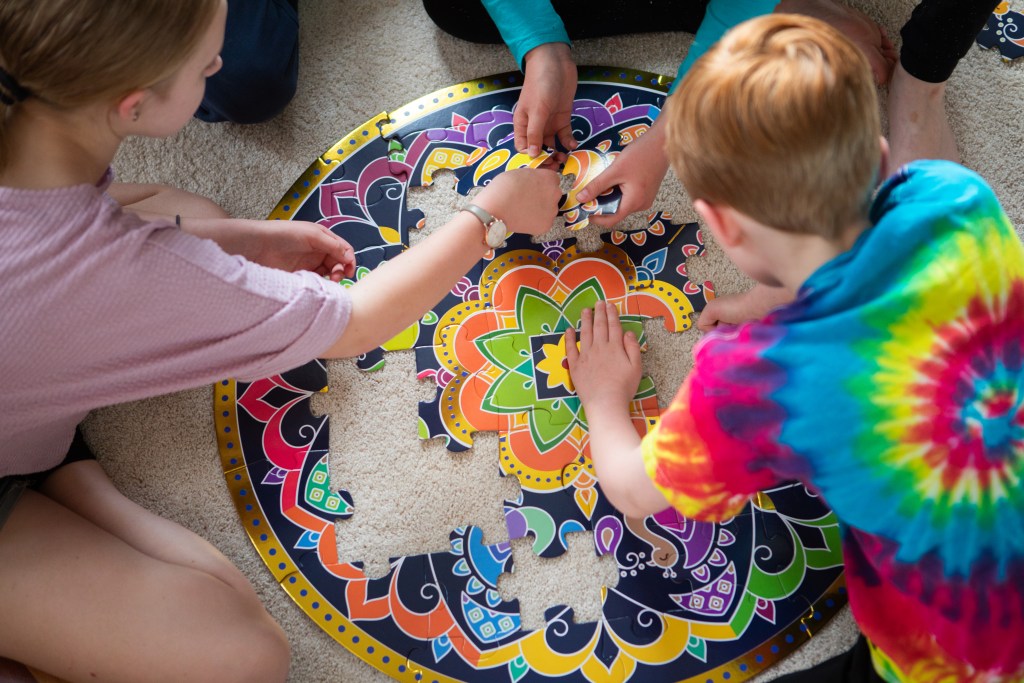
- Build a giant rangoli floor puzzle together. Big pieces are easy for little hands, and there’s no cleanup.
- Color a rangoli mandala and add stickers. Toddlers love filling in the petals.
- Make a flower-petal rangoli on a baking tray, using marigolds or roses from the grocery store.
Ages 5 to 7: patterns and shine
- Try a foil rangoli. Peel-and-press foil gives a sparkly, mirror-like finish without any loose powder.
- Draw a dot grid on paper and connect the dots into a simple kolam.
- Make rangoli with what’s in your pantry: rice, lentils, pasta and dried beans on a paper plate.

Ages 8 to 12: real materials, real art
- Use colored sand or paint on a wooden base to make a rangoli that lasts beyond Diwali.
- Draw Lakshmi’s footprints leading from your front door to your family altar.
- If the weather cooperates, draw a chalk rangoli on the driveway and surround it with LED diyas.
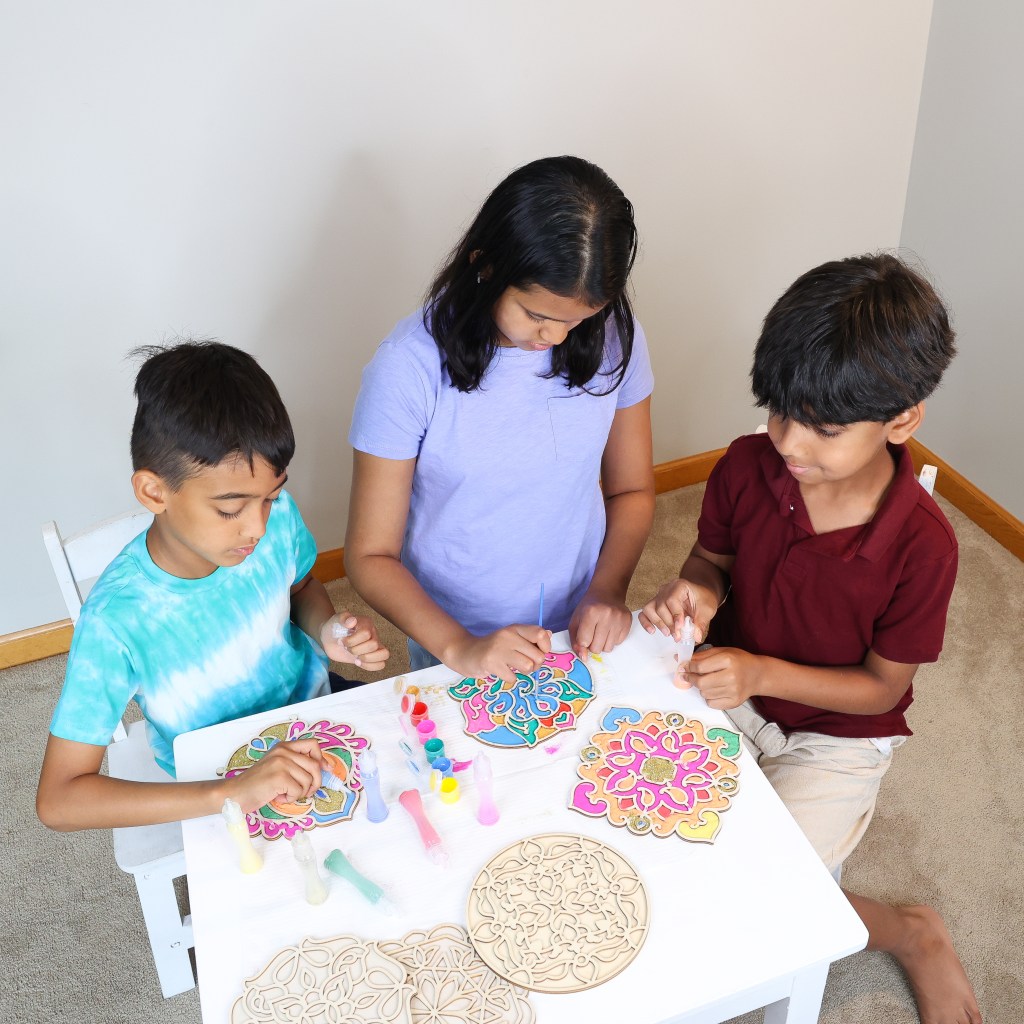
Teens and grown-ups: slow, mindful making
- Make a set of rangoli coasters to use on Diwali night and gift to family.
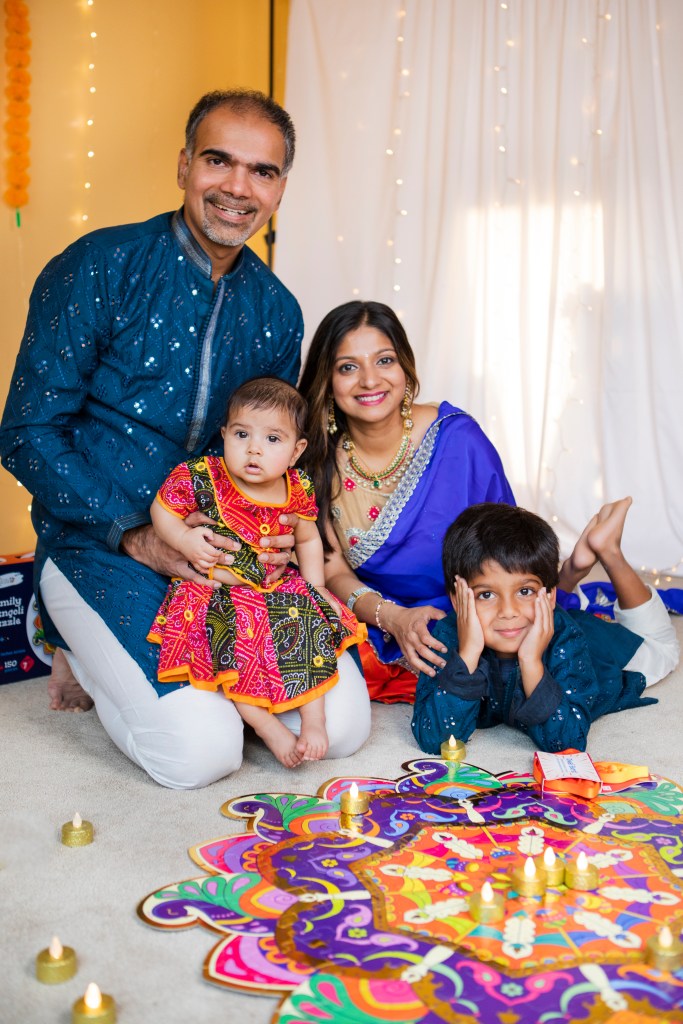
- Take on a 150-piece family rangoli puzzle after the kids are asleep, with a cup of chai.
- Try a freehand rangoli with colored powder on a large tray or board. It’s more meditative than you’d think.
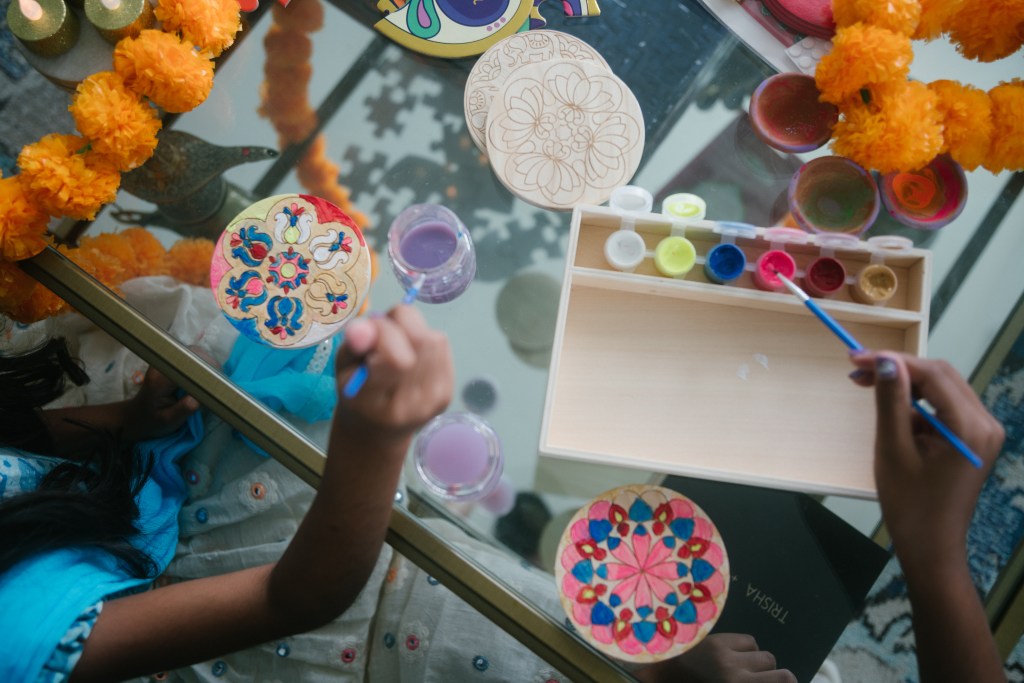
Free rangoli printables
If you want to start today, download our free Rangoli Mandala coloring sheets. They’re four of the most-loved designs from our coloring book, and they’re perfect for a classroom, a Diwali party or a quiet afternoon at the kitchen table.
Shop this post

Every one of these was made for families like mine, who want to share rangoli with their kids wherever they live.
- Rangoli Mandala Bundle: the original giant 32-inch floor puzzle that started it all, plus the Coloring & Sticker Book. Best for ages 3 and up.
- Mirror Magic Silver Foil Rangoli Puzzle: a shimmering 75-piece giant floor puzzle. Ages 4 and up.
- Foil Craft Kit: Rangoli Mandala: peel, press and shine. Makes six boards. Ages 4 and up.
- Wooden Rangoli 2-in-1 Sand Art & Paint Kit: real rangoli materials on a keepsake wooden base.
- Make Your Own Rangoli Coaster Kit: four wooden coasters for teens and grown-ups.
- Family Rangoli Puzzle, 150 pieces: a tabletop puzzle for the whole family.
- Rangoli Mandala Coloring & Sticker Book: hours of coloring for kids and adults alike.
You can also find Kulture Khazana at select Target stores starting October 11, and on Amazon.
For everything else you need this season, from the five days of Diwali to stories, activities and gifts, visit our complete Diwali 2026 family guide. If you’re new to Diwali with little ones, start with Diwali for Kids: How to Celebrate the Festival of Lights with Your Family.
However you make it, with powder, petals, rice or puzzle pieces, I hope your doorstep glows this Diwali. And if your kids make a rangoli this year, I’d love to see it. Tag us @kulture_khazana.
Frequently asked questions
What is rangoli and why is it made during Diwali?
Rangoli is a colorful floor design made at the entrance of a home using colored powders, rice flour, flowers or sand. During Diwali, it’s made to welcome guests and Goddess Lakshmi, who is believed to bring prosperity and good fortune into the home.
What does the word rangoli mean?
The word is often traced to the Sanskrit rangavalli, meaning “a row of colors.” In different parts of India, the art is also called kolam, muggu, alpana, mandana, aripan, aipan and jhoti.
What is the difference between rangoli and kolam?
Kolam is the South Indian form of rangoli, especially in Tamil Nadu. It’s usually drawn with white rice flour around a grid of dots and is often made fresh every morning, while rangoli in western and northern India tends to use bright colored powders and is made especially for festivals like Diwali.
When should I make rangoli for Diwali 2026?
Diwali 2026 is on Sunday, November 8. Many families make rangoli starting on Dhanteras (Friday, November 6) and refresh it through Diwali and the New Year on November 9.
How can kids make rangoli indoors without a mess?
Rangoli floor puzzles, foil craft kits, coloring sheets and paper-plate rangoli made with rice or lentils are all mess-free ways for kids to make rangoli indoors, which is especially helpful in colder parts of the U.S.
What is rangoli made of?
Traditionally, rangoli is made from rice flour, colored powders, flower petals, turmeric, kumkum and sand. Today, families also use chalk, colored rice, lentils, and craft kits.
Can people who don’t celebrate Diwali make rangoli?
Yes. Rangoli is a welcoming art, and making one is a lovely way for classrooms, friends and neighbors to learn about Diwali and Indian culture with respect and joy.